Today is World Ocean Day. Your Instagram feed is probably full of blue graphics and “protect our oceans” captions from brands that have never once looked at their supply chains. So let’s skip the aesthetics and talk about what’s actually happening.
How the Fashion Industry Is Polluting the Ocean
The ocean covers over 70% of the planet. It produces at least half the oxygen we breathe. More than 3 billion people rely on it for their livelihoods, including food and energy. And right now, it is being absolutely overwhelmed by plastic.
There are an estimated 75 to 199 million tons of plastic already in our oceans, with roughly 33 billion pounds more entering every year. More than a million seabirds and 100,000 marine animals die from plastic pollution annually. A hundred percent of baby sea turtles have plastic in their stomachs.
That last one is worth sitting with.
Most of the conversation around this problem focuses on plastic bags, straws, and packaging. And yes, those matter. But there’s a source that gets far less attention: our clothes.
Fashion Is One of the Biggest Plastic Polluters You’ve Never Thought About
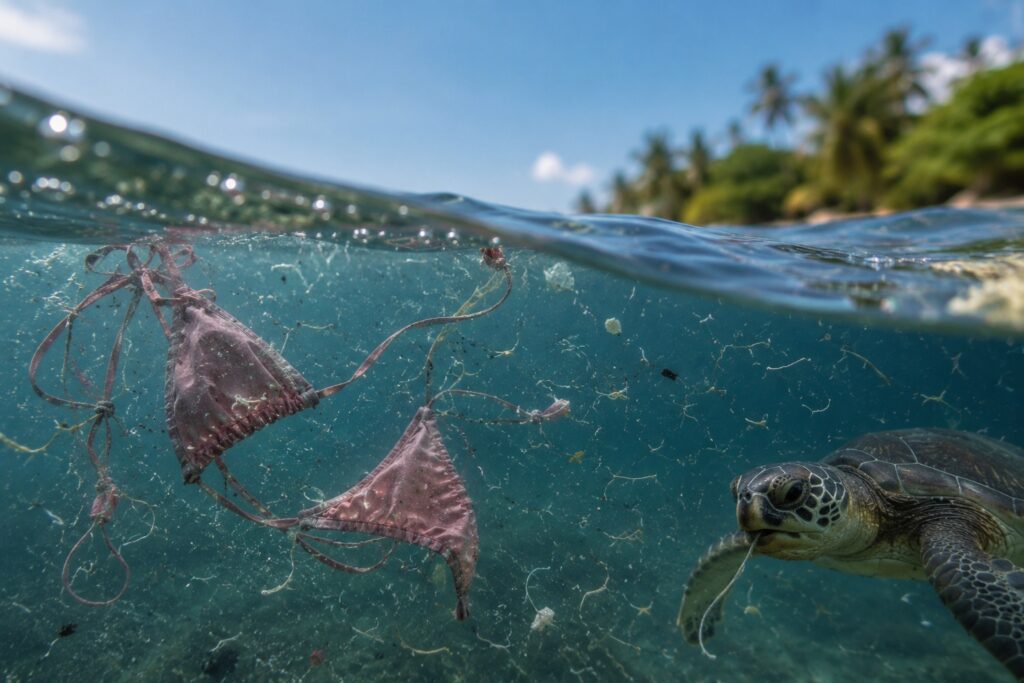
About 60% of material made into clothing today is plastic — polyester, acrylic, nylon. Every time you wash a synthetic garment, it sheds microscopic plastic fibers. Those fibers pass through most wastewater filters. They flow into rivers. They end up in the ocean. Over a third of all microplastics released into the world’s oceans come from synthetic textiles. Between half a million and a million tons of plastic microfibers are discharged into wastewater each year just from washing synthetic clothes.
Up to 700,000 fibers can come off your synthetic clothes in a single wash. One wash. One garment. Multiply that by the billions of people doing laundry every week, and the scale becomes almost impossible to picture.
Now think about swimwear specifically. Swimsuits are almost entirely synthetic; nylon, polyester, spandex. They’re designed to get wet, which means they’re designed to shed. They’re rinsed constantly. They’re washed regularly. And the fast fashion version is churned out in massive volumes, worn for a season or two, and thrown away.
That suit you bought for $18 on a trendy website? It was likely made from virgin petroleum-based plastic. It shed microfibers every time you wore it. And when you tossed it, it went to a landfill where it will sit for hundreds of years.
What Is ECONYL? The Recycled Fabric Made from Ocean Plastic
Here’s one more piece of the plastic picture you probably haven’t heard. Abandoned fishing nets, known as ghost nets, make up at least 10% of all ocean plastic and according to a 2018 study published in Scientific Reports, they account for 46% of the Great Pacific Garbage Patch, the massive debris accumulation swirling in the Pacific between Hawaii and California. Around 640,000 tons of discarded nylon fishing nets are in our oceans right now. Not biodegradable. Not disappearing. Just drifting, entangling, and killing marine animals for decades.
In 2011, an Italian company called Aquafil decided to pull them out and turn them into fabric.That material is called ECONYL. The process is straightforward: collect discarded fishing nets, carpet scraps, and other nylon waste from oceans and landfills, break it down to a molecular level, and regenerate it into brand-new nylon fiber. Chemically, ECONYL is identical to virgin nylon — same toughness, same durability, same stretch. The only difference is where it came from. For every metric tonne produced, the process saves 16.2 gigajoules of energy, seven barrels of oil, and generates 4.1 fewer metric tonnes of CO2 compared to conventional nylon production. And it can be recycled infinitely without losing quality.
That’s not greenwashing. That’s actual materials science.
Cheeki Swim Founder Gigi Scholbi on Building a Sustainable Swimwear Brand
I had Gigi Scholbi, the founder of Cheeki Swim, on The Lexy Show: Fashion That Gives a Damn.Find her at @GigiScholbi and the brand at @CheekiSwim and cheekiswim.com.
Gigi started Cheeki Swim in Hawaii, sewing out of her apartment, working three jobs, going to school full time. Her first machine broke on the first bikini she made. She still has it on her wall.
She sources deadstock and upcycled fabrics from a family-run reclamation company, from Spoonflower’s on-demand water-based printing, from thrift stores and local fabric shops in Hawaii.
Every piece is handmade in small batches of 20 to 40. When a collection sells out, it’s gone.
She looked at a California manufacturer early on and was shocked, $10,000 for 300 units. That was a hard “no”. Not because she couldn’t eventually afford it, but because she didn’t want 300 swimsuits she wasn’t sure would sell.
She cuts every piece of fabric like a puzzle, using every scrap. The thread that doesn’t work for one suit gets wound onto a bobbin and reused. If your suit gets damaged, she’ll take it back, fix it, and ship it to you.
You can care what your swimsuit is made from and still want it to look incredible. The aesthetics and the ethics don’t have to fight each other.
How Heal the Bay Is Fighting Ocean Plastic Pollution in LA
I’ve partnered with Heal the Bay for Lextober — our Halloween costume donation drive — and what they do is worth knowing about.
Heal the Bay is an environmental nonprofit that has been making LA’s coastal waters and watersheds, including Santa Monica Bay, safe, healthy, and clean since 1985. They started because a group of residents watched the Hyperion Treatment Plant dump sewage into the ocean and decided to do something about it. They forced the city to stop. That’s the kind of organization they are.
Today they run beach cleanups up and down the LA coast, publish a weekly Beach Report Card that grades water quality at over 500 California beaches, and operate the Heal the Bay Aquarium at the Santa Monica Pier — a marine science education center that attracts nearly 100,000 visitors a year and reaches more than 100,000 students through in-house programs annually.
Beach and neighborhood cleanups are just the beginning for them. Their staff works to mobilize LA’s diverse communities to protect the coastline, restore waterways, and advocate for clean water policy across the entire watershed. Lextober is about donating Halloween costumes instead of trashing them — keeping textiles out of landfills and off the street. Partnering those cleanups with Heal the Bay closes the loop: we’re dealing with what’s already in the environment while pushing back on the system that keeps putting it there. If you’re in LA and want to get involved, go to healthebay.org. They have events running year-round, not just in October.
How to Actually Shop Differently This Summer
The good news is that swimwear is one of the categories where your purchasing choices have a direct, traceable impact. Here’s what to actually look for:
Check the material tag. If you see ECONYL or REPREVE, that’s a real signal — those are specific recycled-content materials with traceable origins, not just marketing language. If the tag just says polyester or nylon, that’s virgin plastic.
Ask what happens at the end of life. A swimsuit made from recycled materials but designed to be trashed after two seasons is still a problem. Look for brands that take back old suits or designs for longevity.
Ignore the vibe, check the supply chain. Plenty of brands use ocean imagery and surfer aesthetics without a single sustainable practice behind them. The question isn’t how the brand makes you feel. It’s what they can actually tell you about their materials.
Buy less and wear it more. The most sustainable swimsuit is the one you already own. If it still fits and functions, wear it until it doesn’t. The swimwear industry wants you to replace your suit every season. You don’t have to.
Wash cold, wash less. Every wash releases microfibers. Cold water and shorter cycles shed less. A microfiber filter bag — like a Guppyfriend — catches what your machine doesn’t. These aren’t solutions to a systemic problem, but they’re real reductions in harm.Show up in person. If you’re in LA, do a Heal the Bay cleanup. Go to healthebay.org and find the next one. Picking up trash that’s already on the beach before it washes into the water is unglamorous and it works.
How to Make Your Swimwear Choices Actually Matter
The ocean doesn’t need your Instagram post. It needs your purchasing decisions and your actual presence.
Fashion has a proven, scalable answer to its role in ocean plastic pollution. Ghost nets can become swimsuits. Plastic bottles can become fabric. Organizations like Heal the Bay have been doing the ground-level work for forty years. The technology exists. The infrastructure exists. The conversation we need to be having is why every swimsuit isn’t made this way and why we keep giving our money to the ones that aren’t.
Go listen to the episode with Gigi. Then go check the tag on whatever suit you’re planning to buy this summer. Then go sign up for a beach cleanup.
All three of those things are available to you right now.🎙️ Listen to The Lexy Show: Fashion That Gives a Damn on Apple Podcasts, Spotify, or wherever you get your podcasts.

Follow me on Instagram & TikTok @LexySilverstein