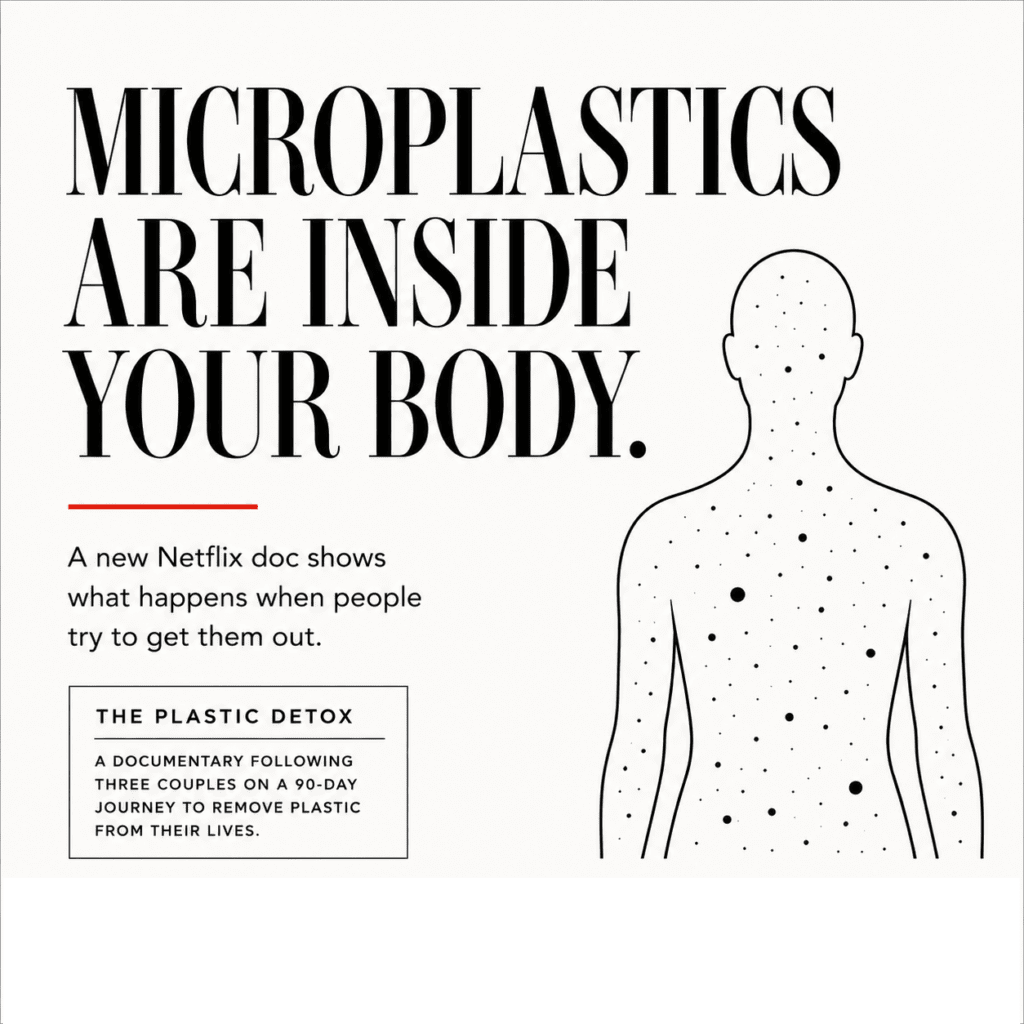
Three couples went into a documentary unable to get pregnant. Three months later, all three were expecting.
That’s not a pitch. That’s what happened in The Plastic Detox, streaming now on Netflix — and if you haven’t watched it yet, let me tell you what’s in it, because it changes the way you look at your closet.
What Is The Plastic Detox and Why Should Anyone Who Wears Clothes Care?
The film follows six couples dealing with something doctors couldn’t explain: they had been trying to conceive for over a year with no medical reason why it wasn’t working. No diagnosis. No answers. Scientists connected this pattern to environmental exposure — specifically, chemicals used in plastics, many of which are endocrine disruptors that interfere with the hormone systems that regulate reproduction.
So the couples agreed to strip plastic from their lives for 90 days. Under the guidance of Dr. Shanna Swan, an award-winning environmental and reproductive epidemiologist who found that sperm counts and fertility rates are declining at a pace too rapid to be explained by genetics alone, they overhauled their kitchens, bathrooms, laundry rooms — and their closets.
Go watch it. Seriously. But if you don’t have 90 minutes right now, here’s what you need to know.
The Results Were Not Subtle
After just three months, five out of six couples saw marked decreases in phthalates and bisphenols — the two chemical classes most associated with hormone disruption. Most of the men’s sperm counts increased. Several couples saw BPA fall to undetectable levels. Three of the six got pregnant.
The results aren’t conclusive — this was not a formal clinical trial, and scientists are careful to say the causal link between microplastics and infertility hasn’t been definitively proven. But the direction of the data was hard to ignore.
And nobody added anything to their lives to get there. They removed things. Their bodies responded.
The Part the Wellness Internet Is Glossing Over: It’s Your Wardrobe
Most of the coverage of this documentary focuses on food containers and kitchen plastic. Fair. But the film goes further than that and this is the part that hits differently when you care about fashion.
The couples replaced synthetic clothing made from polyester, nylon, and spandex with items made from cotton, wool, and other natural fibers as part of the detox protocol. That wasn’t a style choice. That was a measurable chemical intervention.
Clothing made from synthetic fabrics like polyester and nylon sheds microplastic fibers, and petrochemical-based dyes may contain harmful chemicals that can be absorbed through the skin.
Think about what that means for a wardrobe built on fast fashion. A $15 Halloween costume. A $9 polyester minidress. The $25 leggings that feel like a second skin — because chemically, they kind of are.
One participant said she now waits until right before exercising to change into synthetic workout clothes, and no longer uses synthetic leggings as loungewear. Small shift. But she made it because she saw her own lab results change.
What Researches Are Actually Finding Inside the Human Body
This is not speculative anymore.
Researchers have found microplastics in placentas, breast milk, and even the heart and brain. A 2025 study published in Nature Medicine confirmed that concentrations of microplastics in human brain tissue increased significantly between 2016 and 2024.
Americans are ingesting plastic and inhaling plastic. The plastic from your tea bag ends up in your beverage. It ends up in your food when you store it in a plastic container and reheat it. And it’s shedding off the synthetic clothes on your body while all of that is happening.
Where is the Law on Any of This? Barely Anywhere.
Here’s what makes this infuriating.
Apart from the Microbead-Free Waters Act of 2015, which bans microbeads in rinse-off cosmetics, no federal legislation directly regulates microplastics. This April, the EPA designated microplastics a “priority contaminant group” and HHS launched a $144 million research program but neither action regulates anything directly.
California has proposed adding microplastics to its Candidate Chemicals List, a category that explicitly includes polyester apparel and other textiles but that’s still working through rulemaking. As of right now, no U.S. state has enacted regulations that explicitly address microplastics as a distinct regulated category.
The industry is not being told to change. Which means you’re on your own.
The U.S. Is Falling Behind on Microplastics Regulation. Here’s What Other Countries Are Already Doing
Microplastics don’t stop at borders. The same particles showing up in American brain tissue are showing up in blood samples in Berlin, placentas in Paris, and drinking water across Asia. This is a global problem. The difference is what governments are choosing to do about it.
The European Union is not waiting around.
The EU has already passed a regulation specifically targeting microplastic pollution from plastic pellets — the industrial raw materials used to make nearly every plastic product — requiring all companies handling more than five tonnes of pellets per year to avoid, contain, and clean up any spills or losses. That law took effect in December 2025. The EU’s 2030 target is to reduce microplastic release into the environment by 30%. There is a target. There is a deadline. There is enforcement.
On intentionally added microplastics — the kind found in cosmetics, personal care products, and synthetic textiles — the EU has already banned the most egregious categories, with phased bans rolling out through 2035 for cosmetics including lip, nail, and makeup products. Cosmetics sold after certain deadlines will be required to carry labels that say: “This product contains microplastics.”
Imagine seeing that on a label at Sephora.
The UK is moving in the same direction. England and Wales are preparing legislation to ban the sale of wet wipes containing plastic — Wales bans them from December 2026. Japan and South Korea are implementing deposit-refund systems and ambitious recycling targets. Colombia and Chile have already passed legislation targeting e-commerce plastics.
Meanwhile, in the US: a 2015 ban on microbeads in face wash, some state-level study bills, and a very recent EPA designation that doesn’t regulate anything yet.
The science is the same everywhere. The urgency clearly isn’t.
Why Secondhand Shopping Is a Different Conversation After Watching This
When you buy secondhand, you are not generating new synthetic garments. You’re not funding new polyester production. You’re not adding more plastic fiber to the cycle and you’re not absorbing petrochemical dyes from fabric that’s never been washed.
A garment that already exists and gets worn again doesn’t require new chemical processing. It doesn’t ship in plastic packaging from an overseas factory. And when you’re done with it, donating it keeps it out of a landfill where it breaks down and sheds microplastics into soil and groundwater for decades.
The pattern the documentary found across every household was unmistakable: the more products people used, the higher their chemical exposure. Simply using fewer products immediately lowered those levels.
The argument for secondhand fashion has always had an environmental case. The Plastic Detox makes it a personal health case too.
What You Can Actually Do Right Now — Especially If You’re Pregnant or Trying to Conceive
Swap synthetic for natural fibers. This is exactly what the couples in the film did. They replaced clothing made from polyester, nylon, and spandex with cotton, wool, and other natural fibers as part of the detox protocol. You don’t have to throw out your entire closet. Start with what’s closest to your skin for the longest — pajamas, underwear, loungewear, baby onesies. PIRG
Look for OEKO-TEX Standard 100 certification — but understand what it does and doesn’t mean. OEKO-TEX certification means every component of the fabric — threads, dyes, buttons — has been tested and proven free of over 100 harmful chemicals, including phthalates. For babies, the standards are even stricter. This is the label worth knowing. But here’s the important caveat: OEKO-TEX doesn’t test for fiber shedding, so a 100% polyester piece can still pass — it just means those plastics don’t contain specific regulated toxins. OEKO-TEX on a natural fiber garment is your strongest option. OEKO-TEX on synthetic is better than nothing, but it’s not the full picture.
Ditch the fragrance. This one showed up across every single household in the documentary. Phthalates are added to personal care products to make fragrances last longer. Laundry detergent, fabric softener, dryer sheets, perfume, scented lotion — if it says “fragrance” in the ingredients and you can’t see what that fragrance actually is, that’s the chemical you’re trying to reduce.
Stop microwaving plastic. Switch to glass storage. Glass containers are thrift store staples — this swap costs almost nothing secondhand.
If you’re pregnant or trying to conceive, treat this as non-negotiable. Researchers have found microplastics in placentas and breast milk. The film’s most urgent finding isn’t about landfills. It’s about what’s passing from one body into another before a baby is even born. The couples who saw the most dramatic results weren’t doing anything extreme. Cotton over polyester. Fragrance-free products. Food stored in glass. That’s it.

Lexy Silverstein