Shopping secondhand is supposed to be the alternative to buying something new. But anyone who actually shops vintage knows the trade-off: it can take more work.
You find a bag you love, but the label means nothing to you. A jacket looks designer, but you have no idea what year it’s from. You see the perfect dress on someone online, but searching “black dress with weird neckline and gold buttons” gets you nowhere.
That’s why I was interested when Google invited me to an event focused on some of its newest shopping and search tools. I wanted to use them for the way I actually shop: vintage, resale and secondhand.And I left thinking about two very different questions.
First: Can AI make secondhand shopping easier? I think the answer is yes.
Second: Can AI tell us which fashion choices are actually sustainable? That answer is much messier.
How Can Google Lens Help You Shop Vintage and Secondhand?
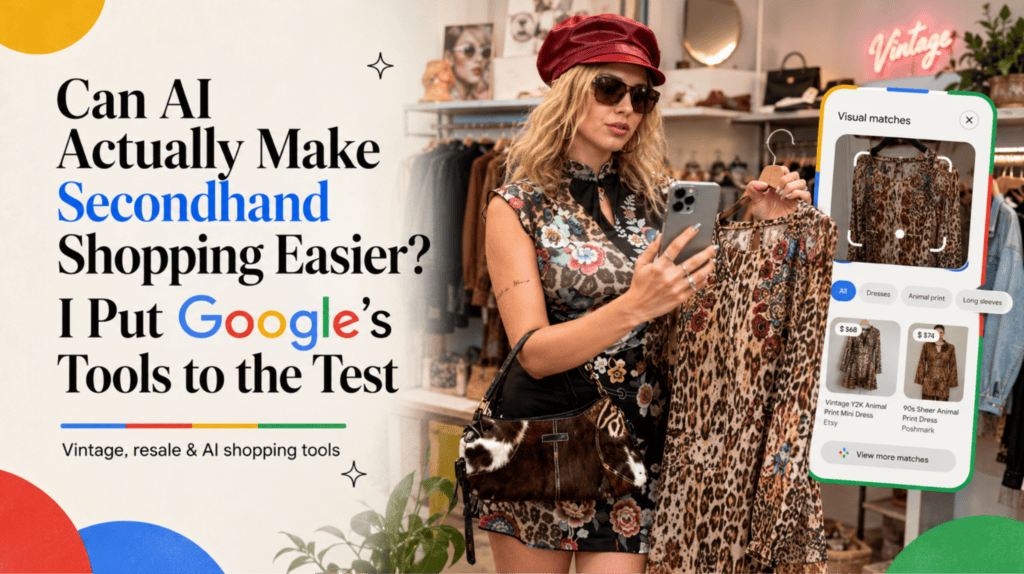
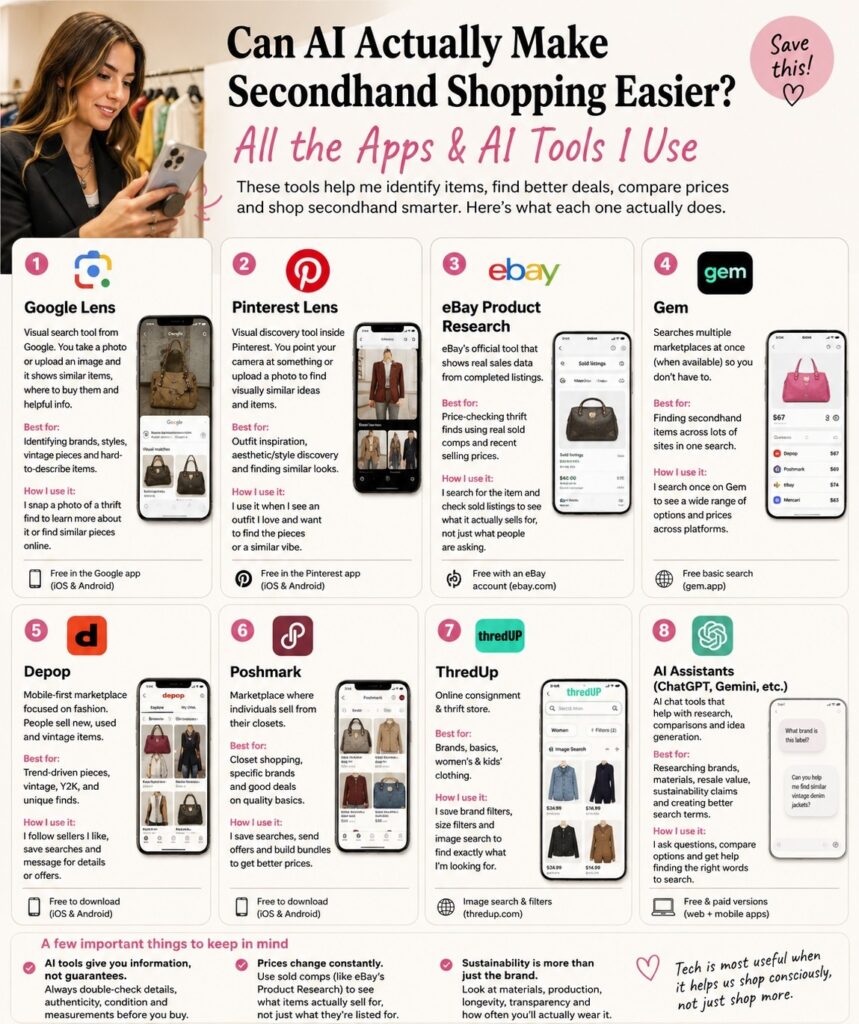
Google Lens might be one of the most useful tools for vintage shopping because vintage is often hard to search for in words.
At the event, I was able to use Lens to search visually instead. You point your camera at an item or upload a photo, and Google searches based on what it sees rather than relying entirely on whatever description you can come up with.
Google actually promotes Lens specifically for thrift and vintage shopping. It says shoppers can use it to find visual matches and learn more about an item, including potentially its designer or era. That sounds simple, but think about how useful it is in an actual vintage store.
Maybe you find a handbag with no obvious model name. Instead of typing ten different versions of “brown vintage shoulder bag,” you can photograph the bag itself and look for similar ones. Or maybe you find a jacket and recognize the label but have no idea whether it’s from 1996 or 2016. Lens can give you somewhere to start.
That last part matters: somewhere to start.
I would never take one visual match as proof that a vintage piece is authentic, from a certain year or worth a certain amount of money. A seller online could have identified their item incorrectly too. But suddenly having the right terminology, similar listings and other visual references makes the research process so much easier.
Can Google Help You Find a Secondhand Version of Something You See Online?
This may be even more useful than identifying something already sitting on a vintage rack. One of my biggest frustrations with fashion online is seeing something I love and immediately being pushed toward buying the new version.
But what if the first step wasn’t buying it?
What if it was just figuring out what it is?
Google’s Circle to Search can identify fashion items you see on your phone without making you leave the app you’re using. Google recently expanded the feature so it can recognize multiple pieces in an outfit rather than making you search each item separately.
So you could see an outfit you love, identify the jacket or style, and then use that information to go looking for a vintage or resale version. Google even gives a very secondhand-specific example: circle a vintage designer handbag or a vintage-inspired item and then ask for similar styles with a ’90s vibe.
That is the part I find exciting.
AI doesn’t have to make it easier to buy the exact new thing you’re looking at. It can make it easier to figure out what you’re looking at, which gives you a much better shot at finding it secondhand.
Could AI Make Secondhand Shopping as Easy as Fast Fashion?
This is where I think the sustainability conversation gets more interesting. Fast fashion isn’t successful only because it’s cheap. It’s also ridiculously easy. Search for a trend and you’ll get hundreds of options. Pick your size. Click buy. Done.
Secondhand inventory doesn’t work that way.
One seller might call something a “90s baguette bag.” Another calls basically the same shape a “vintage shoulder purse.” Someone else doesn’t know what it is at all and lists it as a “cute brown bag.” There might be one available in your size, somewhere, listed under a description you would never think to search.
That’s a discovery problem. And AI is actually pretty good at discovery.
Google’s AI Mode can now handle much more detailed shopping questions and pull together things like product information, reviews, prices and availability. The sustainability opportunity here isn’t complicated: If technology can make the used option almost as easy to find as the new one, that’s meaningful. It removes some of the work that has always been part of shopping secondhand.
But there’s an important catch. Making secondhand easier to buy doesn’t automatically make us consume less. If AI helps me find 25 vintage dresses in five seconds and I buy all 25 of them, we haven’t exactly solved overconsumption.
The better question is whether these tools can help us find what we actually want, compare our options and make it easier to choose existing clothing over producing another new item.
Can AI Tell You Which Fashion Brands Are Sustainable?
This is where I trust AI a lot less.
Finding a visually similar handbag is one kind of question. There is usually something concrete to match. “Is this fashion brand sustainable?” is completely different. What does sustainable even mean in that question?
Lowest carbon emissions? Better materials? Living wages? Less water? Less production? More durable clothing? Better chemical management? Repairability? All of it?
Business of Fashion just tested this problem by looking at sustainable-brand recommendations from ChatGPT, Claude and Gemini. The platforms generally recommended brands already known for sustainability or natural materials, but BoF also found that the recommendations could change based on how the question was asked.
That’s a pretty important detail.
If changing a prompt changes which brands are supposedly “most sustainable,” then we’re not looking at some objective master ranking of fashion. We’re looking at an answer to a very particular question.
Why Can AI Get Sustainable Fashion Recommendations Wrong?
Part of the problem is that AI has access to the same messy internet we do. There are company sustainability reports. Marketing campaigns. News stories. NGO reports. Certifications. Rankings. Criticism. Influencer posts. Reddit threads. Brand websites. Some of that information is excellent. Some of it is literally marketing.
A company that talks constantly about sustainability may have a much bigger digital footprint around the word “sustainable” than a smaller company doing strong work without an enormous communications budget.
That doesn’t automatically mean AI will fall for greenwashing every time. It does mean visibility and sustainability are not the same thing.
And this is exactly why I don’t love asking an AI tool: “Is this brand sustainable?” That invites a yes-or-no answer to a question that probably shouldn’t have one.
What Should You Ask AI About a Fashion Brand Instead?
I think AI becomes much more useful when you stop asking it to give a verdict and start asking it to show its work.
Instead of:
Is Brand X sustainable?
Try:
- What evidence supports Brand X’s sustainability claims?
Or:
- Which of Brand X’s environmental claims have been independently verified?
- What percentage of its materials are recycled, certified or lower-impact?
- Has the company published emissions targets, and is it meeting them?
- What criticism has the brand received about labor or environmental practices?
- Which information comes from the company itself versus independent sources?
And my obvious favorite:
- Can I find this item, or something similar, secondhand instead?
Now AI isn’t deciding what’s “good” for you. It’s helping you gather information you can actually evaluate. That’s a much better use of it.
Can Google’s Virtual Try-On Tools Make Fashion Shopping Less Wasteful?
This one’s interesting too. Google now lets shoppers virtually try on clothing using their own photo, and its newer tools can generate try-on images across billions of apparel listings. In theory, anything that helps someone feel more confident about an online purchase before ordering could reduce some bad purchases. I say it very intentionally.
Virtual try-on isn’t the same thing as actually knowing whether a garment fits. It can’t tell you exactly how a fabric feels, whether the waistband digs in or whether you’re going to hate the dress after wearing it for three hours.
And if virtual try-on simply makes it even easier and more entertaining to shop constantly, that’s obviously not a sustainability win either.
Once again, the tool itself isn’t sustainable or unsustainable. It depends on what we’re using it to do.
Is AI Going to Make Fashion More Sustainable?
Is AI going to save fashion’s pollution problem? No. I also don’t think that’s the most useful way to look at it.
What surprised me at the Google event was how many of these tools solve problems secondhand shoppers genuinely have. And sometimes I just need better search terms. For those things, AI and visual search can be incredibly useful.
Where I get uncomfortable is when we start treating the same technology like an authority on sustainability. Neither one should make the final decision for me.
That’s probably the biggest thing I took away from using these tools: AI is really good at helping us find more information. That doesn’t mean we should outsource our judgment to it. And maybe that’s where technology actually has a role in making fashion better. Not by telling us what to buy.
By making it easier to search secondhand first, figure out what we’re looking at, question the claims we’re being sold and find an existing version of something before automatically buying it new. If AI can make that easier, I’m interested.