I love finding something weird that no one else has.
But my conversation with Kirsten Junor, CEO of Reverse Garbage, made me realize there is a pretty important difference between reusing things and simply finding a more sustainable excuse to keep consuming them.
Because yes, buying secondhand is generally better than buying new.
But do I actually need another purse just because it is $4?
Probably not.
And Kirsten knows a thing or two about reuse.
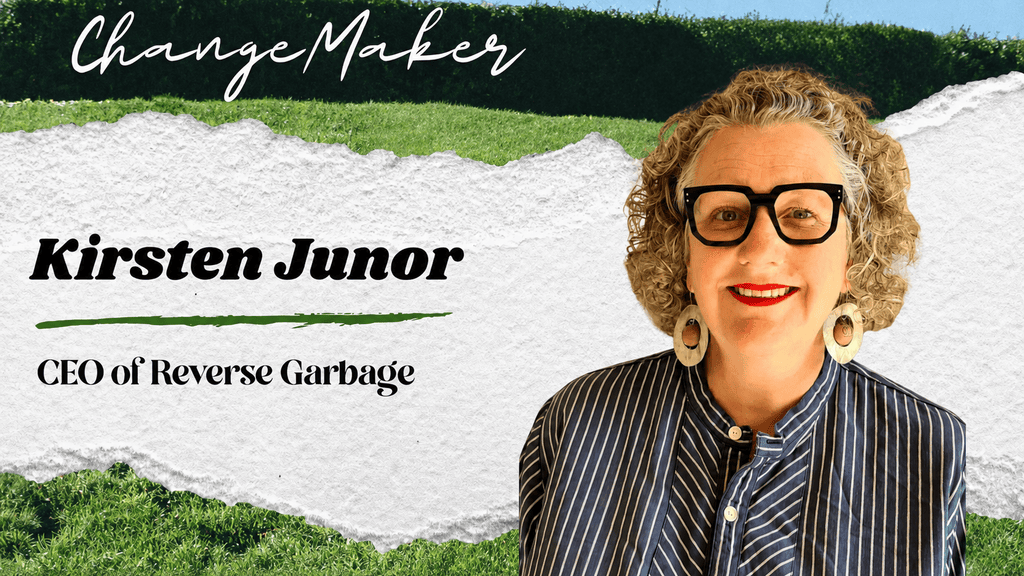
For more than 50 years, Reverse Garbage, a nonprofit creative reuse center in Sydney, Australia, has rescued commercial and industrial materials that would otherwise be discarded and put them into the hands of artists, teachers, students, makers and members of the community.
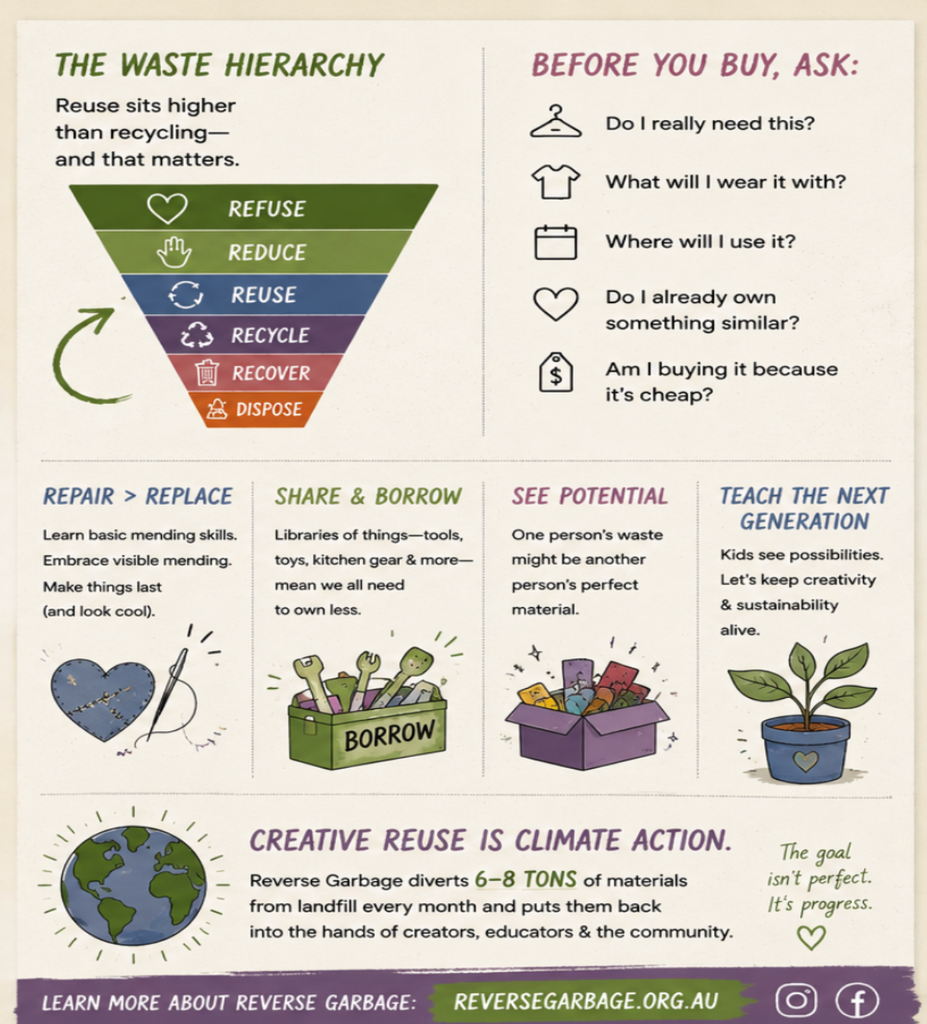
Today, the organization rescues around six to eight tons of material every month.
Not recycles. Reuses. And that distinction ended up being one of my biggest takeaways from our conversation.
Is Reuse Actually Better Than Recycling?
We hear recycle constantly. Recycle your bottles. Recycle your cardboard. Look for recyclable packaging. And obviously, recycling matters.
But Kirsten pointed out something that I think gets lost in a lot of sustainability conversations: reuse sits higher on the waste hierarchy than recycling. Reverse Garbage has been talking about that for 50 years.
The basic idea is pretty simple. Before we use energy and resources to break something down and turn it into something new, could we just… keep using the thing that already exists? Could that fabric become something else? Could that industrial offcut become an art material? Could something one company considers garbage be exactly what somebody else needs? That is basically the entire philosophy behind Reverse Garbage.
And Kirsten was doing it long before she had a sustainability term for it.
Before joining Reverse Garbage, she worked in theater and costume making, where tight budgets meant getting creative with whatever was available. A 1970s suit might need to become a 1940s suit. An old shirt might get screen-printed and transformed for another production.
She didn’t think of it as environmentalism. She thought of it as being resourceful. And I love that distinction because sustainability can sometimes feel like this giant lifestyle overhaul where you need to replace every product you own with a more expensive, perfectly ethical version.
Sometimes sustainability is literally just: Use what you already have.
Can Secondhand Shopping Become Overconsumption Too?
Kirsten brought up the rise of the thrift haul. People proudly showing off giant piles of secondhand things because, technically, they did not buy them new.
And then she said something incredibly simple: Just because something is reused or secondhand does not automatically make buying it sustainable. You still only need so much stuff. Because I have absolutely gone into thrift stores and thought, It’s $2.99. Why wouldn’t I buy it? Meanwhile, I already owned plenty of clothes.
Secondhand shopping can be a fantastic way to keep existing products in circulation and avoid supporting new production. But if we bring the same fast-fashion mindset into the thrift store — buying six things because they are cheap, wearing one of them and eventually getting rid of the rest — we haven’t actually changed the behavior underneath it.
We just changed where we shop. Kirsten has taken that idea pretty seriously in her own life.
She told me Australians are among the world’s highest consumers of clothing, and said she has personally challenged herself not to buy any clothing this year, new or secondhand. She makes much of her own clothing instead. The year before, she challenged herself not to buy fabric and to work through what she already owned.
I am not saying everybody needs to stop buying clothes for a year. But it made me think more seriously about asking myself a few questions before I buy something:
Do I actually need this? What am I going to wear it with? Where am I going to use it? Do I already own something that does basically the same thing? And am I buying it because I love it — or because it is cheap and sitting in front of me? Sometimes the most sustainable purchase is the one you never make.
What If We Started Repairing Things Again?
One of my favorite parts of our conversation was talking about sewing and repair.
Kirsten is a big advocate for visible mending: repairing clothes in a way that does not necessarily try to disguise the repair.
The patch can show. The stitching can show. The fact that you cared enough about something to fix it can show. And I LOVE that.
We have gotten so accustomed to things looking perfect that sometimes the minute a button falls off, a seam opens or something gets scratched, it starts feeling disposable.
But knowing how to fix basic things changes your relationship with them.
I remember once sewing a button back onto a pair of jeans in front of a friend, and she acted like I had just performed surgery.
It was a button. Needle. Thread. Done. But those basic skills, sewing on a button, hemming something, repairing a tear, are not as common as they once were. Kirsten also made the point that when you learn to make or repair something yourself, you start appreciating how much work went into creating it in the first place. Once you understand how long it can take to sew something properly, it gets much harder to look at a $5 shirt and not wonder how that price was possible. Sometimes a sewing project will absolutely humble you. But maybe that is part of the point.
Do We Really Need to Own Everything?
Another concept I loved from Kirsten: libraries of things.
Not just libraries with books.
Tool libraries. Kitchen libraries. Toy libraries. Places where people can borrow something they need instead of everybody purchasing their own version of an item they may barely use.
Because how often do we buy something for one specific task?
A drill. A cake pan. Camping equipment. A tool for one extremely specific DIY project that then lives in a closet for the next nine years. We have been trained to think, I need this, therefore I need to own this. But those are two different things. Could you borrow it? Could you share it? Could you rent it? Could somebody else use yours when you are not using it? The circular economy does not only mean finding a better destination for our stuff once we are finished with it. Sometimes it means not creating demand for another product in the first place.
So What Exactly Does Reverse Garbage Rescue?
This was one of the most fun parts of hearing about Reverse Garbage because this is not your typical thrift store. They are not mainly dealing with clothes, dishes and home décor. They rescue commercial and industrial discards.
Think fabric, zippers, coconut fiber, wool, acrylic offcuts and all kinds of strange manufacturing leftovers that most of us would probably look at and immediately label garbage.
But then somebody else walks in and sees the possibility.
Kirsten told me about a woman buying wool that had been discarded by an upholsterer and using it while hiking to protect her feet when she felt a blister forming.
Another customer found a pile of old recessed door handles and realized they were the perfect size to support his collection of vintage toy cars so their rubber tires would not flatten while sitting in storage.
That is the kind of creativity I find so exciting. Something does not have to be reused for its original purpose to still be useful. Sometimes sustainability starts with asking: How can I see this differently?
Why Does Reuse Have to Be Planned Before Something Becomes Waste?
Reverse Garbage also works directly with businesses, and Kirsten explained that one of the biggest changes she has seen is companies thinking about reuse earlier.
In the past, a business might call at the last possible second and essentially say: We are tearing this display down tomorrow. Can you save all of this?
Now, some organizations are considering what will happen to materials while the project is still being designed. That matters. Because sustainability works a lot better when it is built into the plan instead of becoming a panic at the end. It also made me think about how often we treat waste as an inevitable final stage. We make something. We use it. We throw it away. Then we try to figure out whether any of it can be recycled. But what if the question about where something goes next came before it was ever produced? That is a much bigger shift than choosing the right bin.
What Do Kids Understand About Reuse That Adults Forget?
Reverse Garbage was founded by teachers, and education is still a huge part of what the organization does. Kirsten said something here that I really loved: kids still know how to play.
Give a kid a pile of random materials and they do not necessarily see scraps. They see possibilities. Adults are much more likely to look at something and immediately decide what it is supposed to be used for. Kids will make it into a spaceship.
Reverse Garbage takes that creativity and pairs it with sustainability education. In its workshops, participants make things from donated materials, and the organization avoids glue and tape so creations can be taken apart and the materials used again.
Even the art project gets another life.
Kirsten has also noticed a real difference in sustainability awareness among children. When she started at Reverse Garbage, asking kids about the difference between recycling and reuse might have been met with silence.
Today, she says children understand much more about those concepts — sometimes more than the adults around them.
Because if reuse becomes something you learn when you are young, it does not have to become a habit you painfully try to relearn at 25, 35 or 55. It is just normal.
Do You Have to Be Perfect at Sustainability?
No. Thank God. Kirsten was very open about the fact that she has not lived some perfectly sustainable, zero-waste existence. Neither have I. And neither have almost any of us. There can be this weird pressure online to turn sustainability into a purity contest. You forgot your reusable cup? Failure. You bought something new? Failure. Is there plastic in your house? Straight to environmental jail. That is not realistic.
Holding ourselves accountable matters. Changing our habits matters. Consuming less matters.
But beating yourself up because you got one coffee in a disposable cup does not solve climate change either.
Kirsten’s approach felt much more practical: make better decisions where you can, recognize that individual choices exist inside a much bigger system, and keep pushing the companies creating enormous amounts of waste to do better too.
What Makes Reverse Garbage a Real Changemaker?
Reverse Garbage has been doing this work for more than 50 years. Long before “circular economy” became corporate jargon. Long before sustainable living became an Instagram niche. Long before thrift hauls were content. Teachers in Sydney were already asking a remarkably modern question:
Why are we throwing away perfectly useful materials?
Today, Reverse Garbage is still diverting tons of material from landfill, providing affordable resources to creators, educating children and adults and creating a physical community around the idea that waste does not have to be waste.
Kirsten told me generations of families have now grown up with the organization. People who visited as children now return with their own children or grandchildren.
And that may be the part of this story I love most. Because sustainability conversations can become incredibly depressing, incredibly quickly. Landfills. Overproduction. Climate change. Pollution. It is a lot.
Reverse Garbage shows another side of it. People making things. People sharing things. Kids playing. Artists finding inspiration in somebody else’s scraps. Communities figuring things out together. Their slogan says it better than I can: Creative reuse is climate action.
So What Did I Take Away From This Conversation?
I went into my conversation with Kirsten already believing in secondhand shopping and reuse. I left thinking much more about consumption itself. Because sustainability is not just figuring out the least harmful way to buy more things. Sometimes it is buying nothing. Sometimes it is repairing the shirt. Borrowing the drill. Using the fabric already shoved in the back of your closet. Giving something to a friend. Turning something into something completely different. Or simply stopping for five seconds before throwing something away and asking: Could this still be useful? And maybe an even more important question before buying the next thing: Do I actually need it?
And once you do that, you realize how much possibility we have been calling garbage.
Learn more about Reverse Garbage: reversegarbage.org.au
You can also follow Reverse Garbage on Instagram and Facebook to see the materials, projects and creative reuse happening in its Sydney community.

Lexy Silverstein,