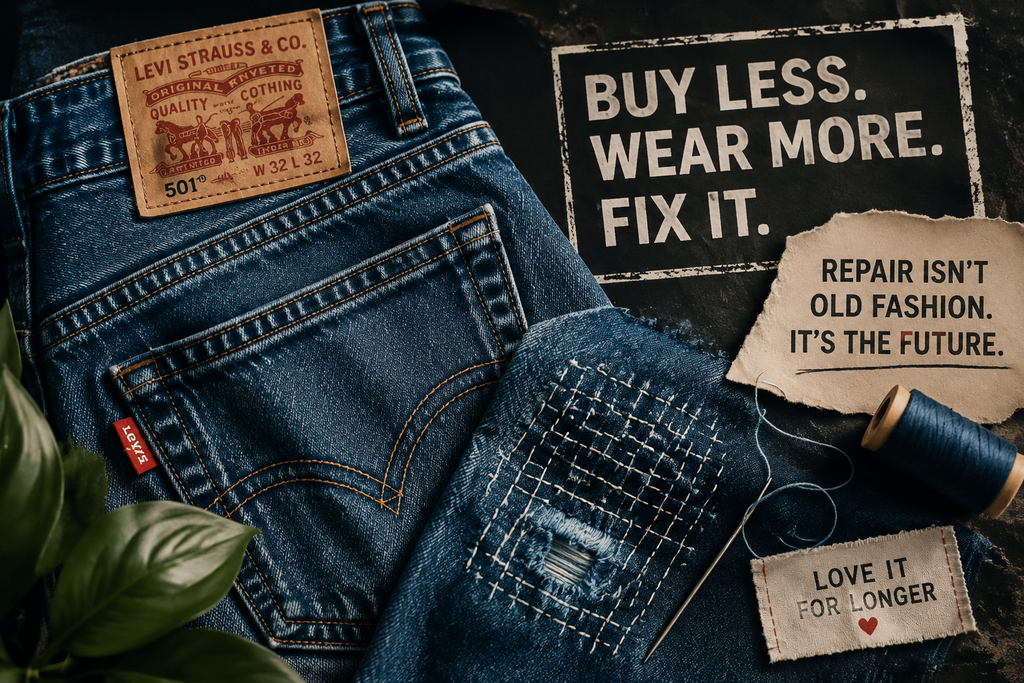
Levi’s has been making jeans since 1853, but today the company is selling something beyond denim: the idea that your clothes can have a longer life.
Fashion has trained us to buy, wear, and replace. So it’s nice to see Levi’s and other major brands start teaching people to do the opposite.
Through initiatives focused on repair, resale, and longer-lasting clothing, Levi’s is pushing back against the idea that a small tear or faded color means it’s time to buy something new. But does that actually make the brand sustainable, or is it just a more responsible version of the same system?
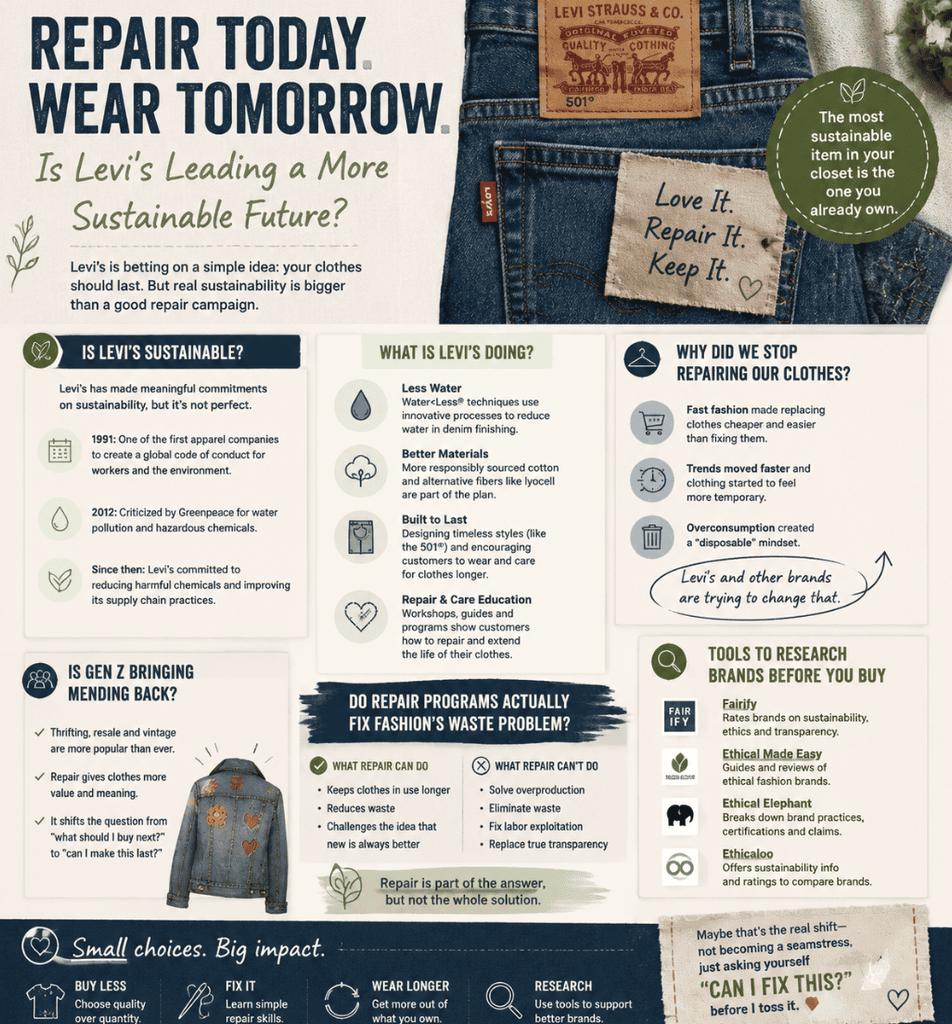
The short answer: Levi’s has made meaningful sustainability commitments, but it is not a perfect example of sustainable fashion.
The company has been working on environmental and ethical issues for decades. In 1991, Levi Strauss & Co. became one of the first major apparel companies to create a global code of conduct for its suppliers, setting expectations around worker rights, workplace conditions, and environmental practices.
But Levi’s has also faced criticism. In 2012, Greenpeace’s Toxic Threads campaign called out fashion companies, including Levi’s, over hazardous chemicals and water pollution connected to textile production. Following that criticism, Levi’s committed to reducing harmful chemicals in its supply chain through its sustainability programs.
That history matters because sustainability is not just about what a brand launches today. It is also about whether a company responds when its practices are challenged.
How Sustainable Is Levi’s Really?
When evaluating whether a brand is sustainable, it is important to look beyond marketing campaigns and examine the bigger picture: materials, manufacturing, labor conditions, and transparency.
Several independent directories can help consumers research brands before buying:
- Fairify rates brands based on sustainability, ethics, and transparency.
- Ethical Made Easy provides guides and reviews of ethical fashion brands.
- Ethical Elephant breaks down brand practices, certifications, and sustainability claims.
- Ethicaloo offers sustainability information and ratings to help shoppers compare brands.
These tools are helpful because sustainability claims can be complicated. A brand may use more recycled materials or reduce water usage while still facing questions about labor practices, overproduction, or supply chain transparency.
What Is Levi’s Doing to Reduce Its Environmental Impact?
One of Levi’s biggest sustainability efforts has focused on reducing the environmental impact of denim production.
Making jeans requires significant amounts of water, which is why Levi’s introduced its Water<Less® manufacturing techniques. The program uses different production methods designed to reduce water use during the finishing process.
The company has also explored alternative materials, including fibers like lyocell, and has worked toward increasing the use of more responsibly sourced cotton.
But one of Levi’s most interesting sustainability arguments is not about making a “perfect” pair of jeans. It is about making clothes that last.
Why Did We Stop Repairing Our Clothes?
For generations, repairing clothing was normal. A ripped jacket, worn-out jeans, or missing button was something people fixed instead of replaced.
Somewhere along the way, that mindset changed.
Fast fashion made replacing clothes cheaper and easier than repairing them. Trends moved faster, clothing became less expensive, and many consumers started seeing garments as temporary.
Levi’s is trying to challenge that idea through repair programs and education around caring for clothing. The company has encouraged customers to wash jeans less often, repair damaged pieces, and keep their favorite items longer.
Can Repair Actually Change Fashion?
I love seeing repair become part of the fashion conversation. But I don’t want a mending workshop to distract from the actual scale of the problem.
Repair programs are encouraging because they challenge the idea that every stain, tear, or missing button is a reason to shop again.
Levi’s is not alone in this shift. Other major brands, including Uniqlo, have introduced repair education and programs designed to help customers extend the life of their clothing.
It sounds backwards for a retailer to teach you not to buy its clothes. But the idea is catching on, especially with younger shoppers already interested in thrifting, resale, and vintage fashion.
Is Gen Z Bringing Mending Back?
Gen Z has helped push sustainability conversations into the mainstream through thrifting, clothing swaps, resale platforms, and renewed interest in vintage fashion.
Repair fits into that movement because it changes the relationship people have with their clothes. Instead of asking, “What should I buy next?” consumers are starting to ask, “Can I make what I already own last longer?”
That shift may seem small, but it challenges one of fashion’s biggest assumptions: that new is always better.
Do Repair Programs Actually Fix Fashion’s Waste Problem?
Repair alone will not solve fashion’s environmental impact.
The fashion industry still faces major challenges, including overproduction, waste, resource use, and questions around worker conditions. A repair program does not erase those issues.
But it can be part of a bigger change.
The most sustainable item in your closet is usually the one you already own. Buying fewer pieces, choosing better-quality clothing, repairing what you can, and researching brands before purchasing all play a role.
Maybe that’s the real shift: not becoming a seamstress or swearing off new clothes forever. Just asking yourself one question before something hits the donation pile or the trash: can this be fixed?
Small step: before you toss a ripped seam or missing button, check if it’s a $5 tailor fix.
Bigger step: before you replace something that’s just worn, look into repair options first — many brands now offer them.
Biggest step: before you buy new at all, check a directory like Fairify or Good On You to see how the brand actually stacks up.
Repair won’t fix fashion’s waste problem on its own. But it’s a start, and it’s one you control today.

Lexy Silversein,