When we talk about sustainability, we usually talk about clothes.
We talk about overproduction. Textile waste. Fast fashion. Microplastics. Greenwashing. And obviously, yes, all of that matters.
But talking to Toban Nichols of Remainders Creative Reuse made me think about a different kind of waste too: the waste we barely even notice.
Fabric scraps. Yarn. Buttons. Paper. Beads. Sewing tools. Half-used paint. Weird little craft materials sitting in drawers, garages and classrooms. The kind of stuff people throw away all the time because it feels too small, too random or too niche to matter.
When those materials get tossed, we are not just throwing away “stuff.” We are throwing away resources, creative potential and access.
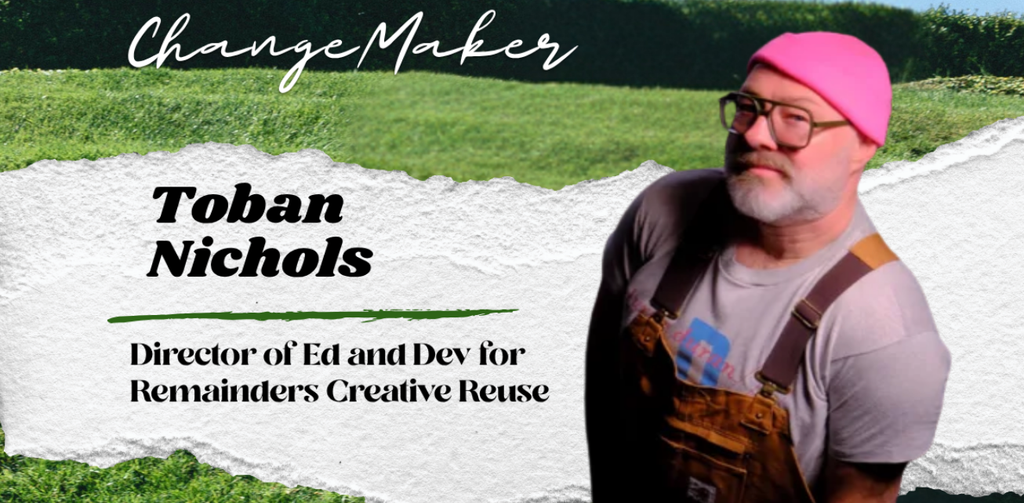
That is what struck me most in my conversation with Toban, director of education and development at Remainders Creative Reuse, a creative reuse center in Pasadena that gives donated materials a second life instead of letting them become trash.
I left that conversation thinking about two things.
First: How much waste do we create simply because we have been taught everything has to be new?
Second: How many people get priced out of creativity before they even begin?
What Is a Creative Reuse Center, Exactly?
Remainders Creative Reuse is part craft thrift store, part classroom, part studio and part community space.
People donate materials they no longer need, things like fabric, yarn, paper, art supplies, tools and other making materials. Then those items get resold at affordable prices so artists, teachers, students, parents and curious beginners can use them instead of buying new.
And yes, that is sustainable in the obvious sense. Materials are diverted from landfill. Fewer new supplies need to be purchased. Useful things stay in circulation longer.
It is also solving a totally different problem: the idea that creativity has to be expensive.
Because honestly, starting anything creative can feel weirdly cost-prohibitive.
If you want to learn to sew, you need fabric, thread, scissors, pins, a machine maybe.
Want to paint? Suddenly you need canvases, brushes, paints, primer and who even knows what else.
If you want to make jewelry, collage, costumes or something mixed-media, good luck not spending money before you’ve even figured out whether you actually like doing it.
That barrier is real. And places like Remainders make it a lot lower.
How Did Toban End Up at Remainders?
This part of Toban’s story is so perfect because it feels tiny, random and incredibly relatable.
He originally found Remainders because he needed one small piece of fabric for a project and did not want to buy a full yard of it. Which, honestly, makes total sense. Why should one small creative impulse require a whole brand-new purchase?
He found the store, walked in, connected with the executive director and kept coming back. Eventually, because Toban was already an art teacher, that relationship turned into teaching classes there and later becoming part of the organization in a much bigger way.
This is such a good reminder that sustainability does not always begin with some giant mission statement.
Sometimes it starts with a very simple thought.
What Does a City Lose Without Places Like This?
One of the most interesting parts of our conversation was when I asked what a city loses if it has thrift stores and recycling centers, but nothing specifically dedicated to creative reuse.
Toban’s answer was basically: a city loses a place to explore its own creativity.
And I think that is exactly right.
We are so conditioned to think that making something means buying something first.
That mindset is not just wasteful. It is limiting.
It makes creativity feel like something reserved for people with extra money, extra space and extra confidence. It turns making into another category of consumption instead of what it can actually be: experimentation, play, reuse, self-expression and problem-solving.
A creative reuse center interrupts that whole cycle.
It says:
You do not need the expensive version. And you do not need to know exactly what you are making before you begin.
Can Used Materials Actually Spark More Creativity?
This is the part I found especially compelling.
Toban talked about how people often assume new materials are somehow better or more “pure” for creative work, but reused materials can actually be more inspiring.
Sometimes having every possible option is overwhelming. But when you are working with what is already in front of you, a cool vintage button, a scrap of patterned fabric, a random spool of ribbon, you start asking different questions.
Not: What should I go buy?
But: What could this become?
That shift matters.
Because creativity is not always about executing a fully formed vision. A lot of the time, it is about responding. Seeing. Playing. Making connections. Letting an object or material suggest the next step.
That is one of the reasons creative reuse feels so aligned with sustainability to me.
What Are People Throwing Away?
Apparently, a lot.
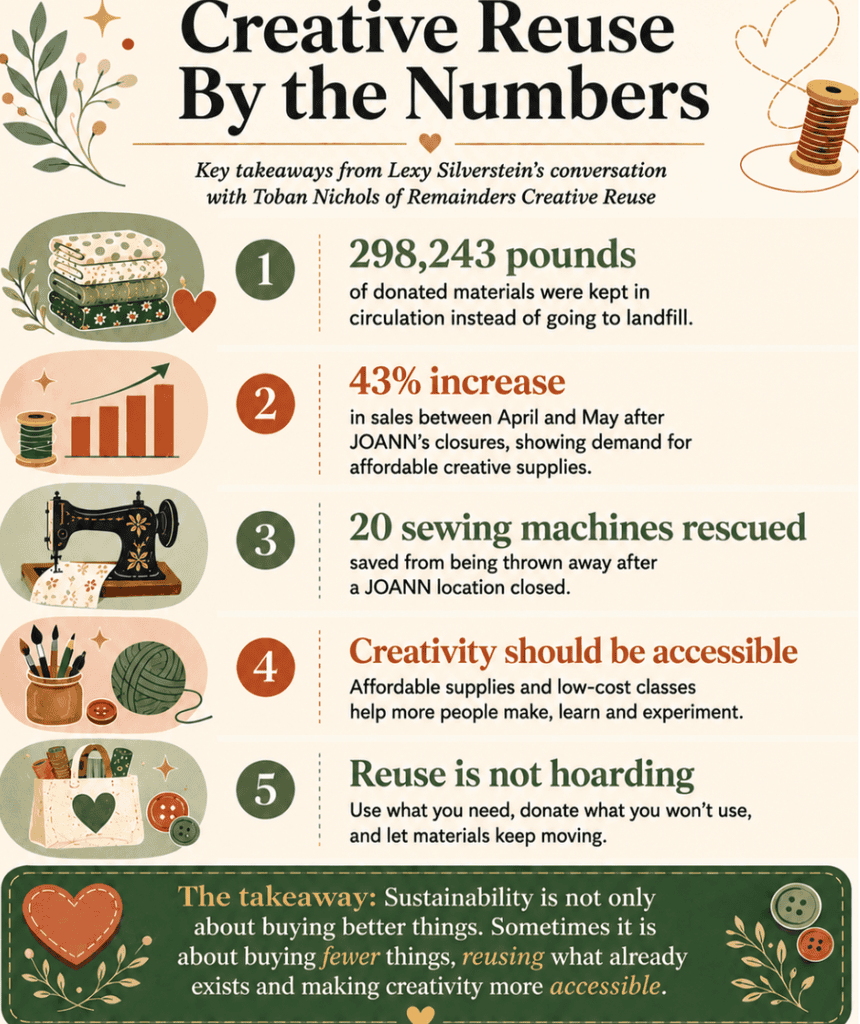
Toban told me they divert thousands of pounds of materials from landfill every month. Someone once donated a Rolex.
In our conversation, Toban mentioned that another person wanted to donate a grand piano. And maybe the most ridiculous story of all: after JOANN closed, someone saw sewing machines being thrown away and rescued about 20 of them from the trash.
Twenty sewing machines.
That story honestly made me want to scream a little.
Because it gets at something much bigger than crafting. We throw away so many things that are still functional, still useful and still deeply wanted by someone else.
Not because they are broken.
But because our systems are built for disposal, not redistribution.
And that is exactly why creative reuse matters; It creates a place for materials to go besides the landfill.
This was one of the most specific and surprising parts of the conversation.
Toban told me that between April and May of 2025, sales jumped 43% following JOANN’s closure.
That is a huge number.
Part of that was practical. People needed another source for supplies. Some donors also stepped up because they knew a community resource had disappeared.
But what stood out to me even more was what that increase represented emotionally.
People were genuinely sad.
JOANN was not just a store. For a lot of people, it was part of their creative life. It was where they bought fabric growing up. It was where projects began. It was familiar. Accessible. Ritualistic.
So when it disappeared, people did not just lose a retail option.
They lost a creative touchpoint.
And what Remainders offered in that moment was not just inventory. It was continuity. A place to keep making. A place to still belong.
That is why it feels too small to describe places like this as just stores.
They are community infrastructure.
Is Craft Waste Part of the Sustainability Conversation?
When people think about waste, they do not always think about crafts. Crafting feels wholesome. Creative. Personal. Slower than fast fashion.
And it can be all those things, but it can also generate waste.
None of that makes creativity bad. It just means creative consumption is still consumption.
And if we care about sustainability, we should care about how we source materials, how we store them, how much we buy and what happens when we are done with them.
That does not mean no one should ever buy new supplies. It means we should probably ask better questions first.
Can Crafting Be an Alternative to Scrolling?
This part of the conversation felt so real to me because I have absolutely had the experience of spending way too much time on my phone and then feeling like my brain has been replaced with mush.
We ended up talking about how crafting can be a totally different way to spend that time.
Not necessarily productive in some hustle-y sense.
And I think that matters.
Because sustainability is not only about materials. It is also about habits.
What do we reach for?
What do we value?
What kind of pace are we living at?
There is something really powerful about choosing to make something with your hands instead of disappearing into a screen for three hours and somehow emerging more tired than when you started.
That does not mean every craft project is relaxing. Sometimes a sewing project will absolutely humble you.
But the larger point still stands:
making things can reconnect us to time, materials and attention in a way consumption rarely does.
What Makes Remainders a Real Changemaker?
It’s keeping materials out of landfill and making creativity more affordable.
Sometimes it looks like a room full of donated supplies, a teacher finding affordable materials, a beginner trying something for the first time, or saving a sewing machine from the trash.
That is what I love about this kind of work.
It is both local and practical.
And it reminds us that one of the most sustainable things we can do is extend the life of what already exists.
So What Did I Take Away From This Conversation?
Probably this:
Sustainability is not only about buying better things. Sometimes it is about buying fewer things, reusing what is already here and making creativity more accessible in the process.
Talking to Toban made me think about how often we confuse “new” with “necessary.”
How often we underestimate the value of scraps, leftovers and hand-me-down materials.
How often we treat creative tools as disposable when they could still have a whole second life ahead of them.
Remainders is not just rescuing stuff. It is keeping creativity accessible. Because sometimes sustainability isn’t about finding the perfect eco-friendly product. It’s about looking at what’s already here and asking: what could this become instead?
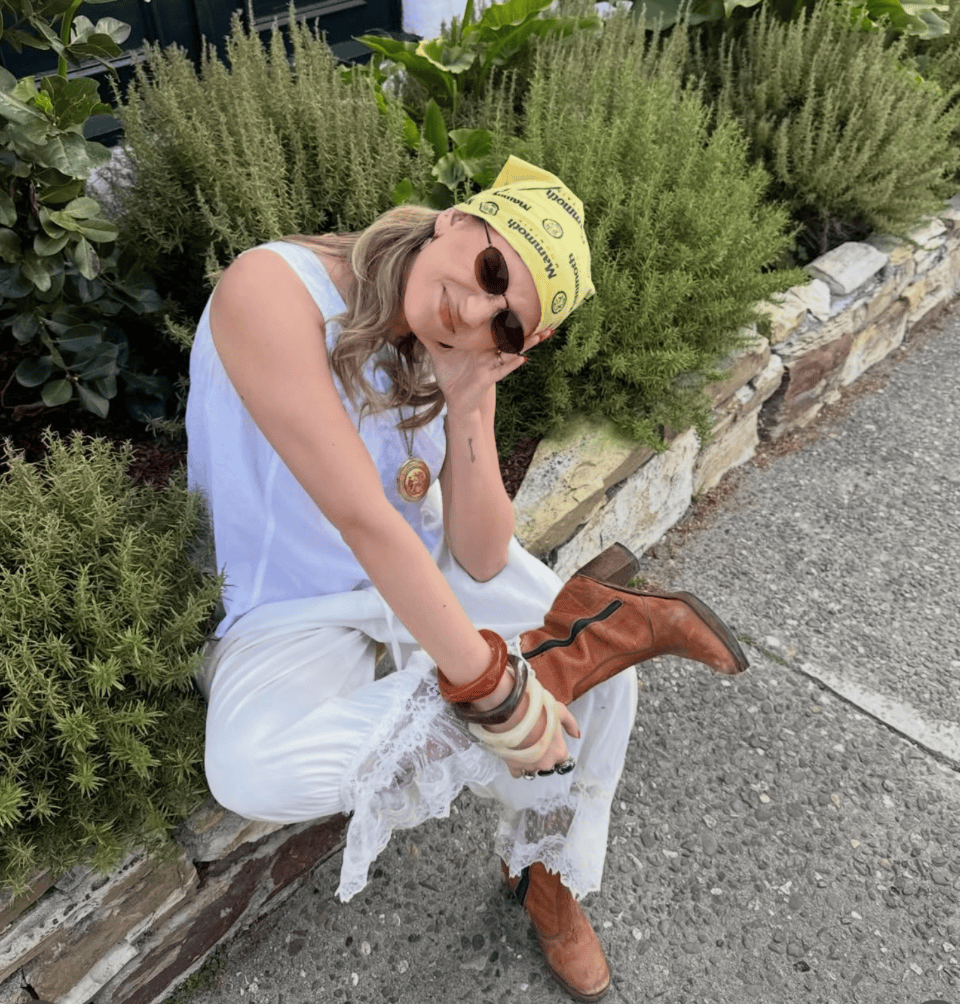
Lexy Silversein,