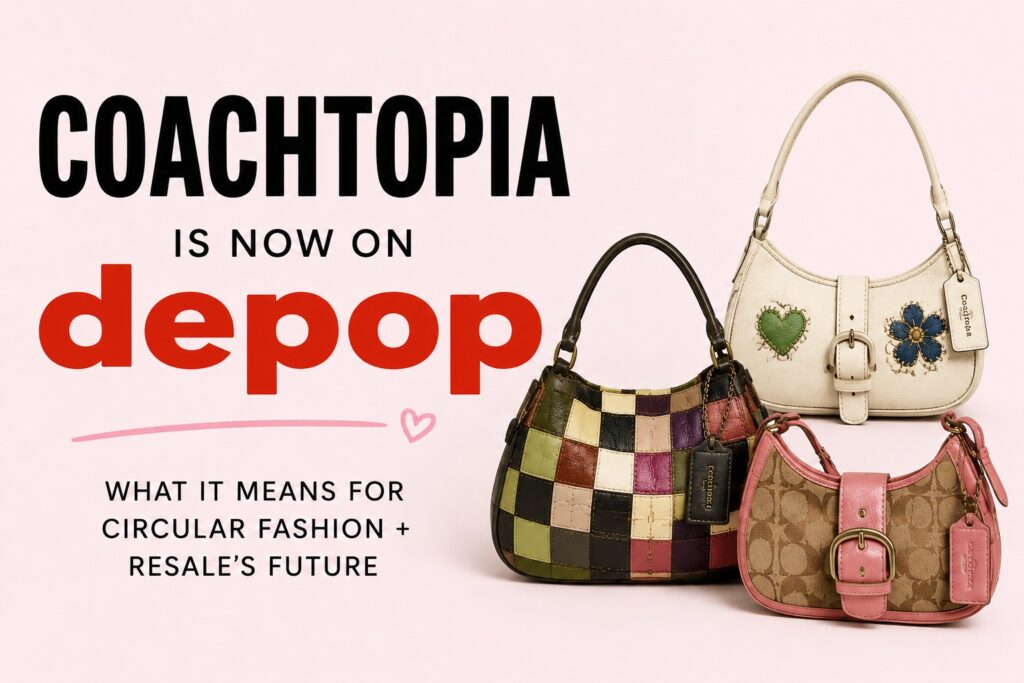
Coachtopia just opened an official shop on Depop. New bags. Restored bags. Vintage Y2K Coach finds. All in one place, at depop.com/coachtopia.
On the surface, it sounds like a pretty standard brand launch announcement. A sub-brand opens a storefront on a resale app. Fine.
But there’s a lot happening underneath that press release that’s worth paying attention to. Because this isn’t just about one brand opening a storefront — it’s a sign that major fashion companies are starting to rethink how they participate in the secondhand economy.
What is Coachtopia? Coach’s Circular Sub-Brand Explained
Coachtopia launched in April 2023 as Coach’s circular-focused sub-brand. It’s not a greenwashing rebrand or a “conscious collection” line. The materials are specific and auditable. The leather used in Coachtopia bags is made with at least 50% recycled leather scraps from tanneries, and carries a carbon footprint at least 60% lower than virgin leather. The flagship Alter/Ego collection takes it further: those bags are made from the actual scraps left over after Coach cuts its iconic Tabby and Brooklyn bags from hides. The offcuts that would otherwise go to landfill get stitched into checkerboard patterns. The result is a bag with a 59 to 80% lower carbon footprint than a comparable style made with new materials.
That’s not a vague sustainability claim. That’s a traceable supply chain decision.
The Depop shop also carries the first-ever restored Coachtopia bags, pre-loved pieces that have been repaired and reimagined through craftsmanship into one-of-a-kind items. So in a single storefront, you’ve got newly made circular bags, restored pre-loved bags, and vintage Y2K Coach archive finds sitting side by side.
Why Coachtopia Chose Depop Over Building Its Own Resale Platform
Coachtopia could have built its own resale portal. Plenty of brands have. Instead, it went to where the community already exists.
Depop had approximately $1 billion in gross merchandise sales in 2025, with nearly 60% year-over-year growth in the U.S. Its 7 million active buyers are almost entirely under 34. And crucially, most of them aren’t opening the app because they care about textile waste. They’re there for the find. The vintage piece, the archive gem, the thing that doesn’t look like anything else in their closet.
That’s the insight Coachtopia is working with. Jen Yue, SVP of Coach Strategy and Consumer Insights, said in the official announcement: “We loved the idea of creating a space where the thrill of discovering something unexpected meets the quality and craftsmanship that define Coach.” Steve Dool, Senior Director of Brand and Creative at Depop, added that Coachtopia’s approach to reimagining existing materials “deeply resonates with our community.”
Neither of them is leading with sustainability as the pitch. They’re leading with discovery. That’s smart.
The Depop Detail Nobody Is Talking About: A $1.2 Billion Acquisition in Progress
Here’s what almost no one covered: Coachtopia launched its Depop shop at the same time that Depop itself is mid-acquisition.
In February, eBay announced it was purchasing Depop from Etsy for $1.2 billion in cash, with the deal expected to close by end of Q3 2026. Etsy originally bought Depop in 2021 for $1.625 billion, meaning it’s selling the platform at a loss. The move allows Etsy to refocus on its core handmade marketplace while eBay doubles down on fashion resale.
What that means for Depop’s culture, its Gen Z seller community, and its position as an indie-adjacent fashion discovery platform is genuinely unclear. eBay is 30 years old. Its stated plan is to integrate its logistics infrastructure, shipping solutions, and Authenticity Guarantee program into the Depop experience.
Coachtopia is building a brand presence on a platform in the middle of one of the biggest ownership transitions in resale history. That might be a bold bet. It might also just be very good timing — locking in brand equity before the platform changes hands and potentially changes character.
What Brands Joining Resale Platforms Signal for Sustainable Fashion
For years, the conventional wisdom in sustainable fashion was that brands needed to build their own resale ecosystems to retain value and control the secondhand narrative. Coach tried that with Coach (Re)Loved. Now Coachtopia is bypassing that model entirely and going to the platform that already has the audience.
That’s a meaningful change in strategy. Brands used to treat resale as a threat to primary sales. Then they tried to own it. Now some of them are just participating in it.
It doesn’t mean every brand partnership with a resale app is automatically good for the planet. Plenty of brand “sustainability” announcements are marketing exercises with no material change underneath. But Coachtopia’s materials claims are specific enough to verify, and the decision to restore and resell its own bags rather than just sell new ones through Depop is a meaningful proof of concept.
The trade-in program is worth noting too. Bring your Coachtopia or Coach bag to any Coach store year-round and receive store credit. It’s one of the cleaner circular loops a major brand has actually built and maintained — not a pop-up stunt, a permanent program.
I’ve spent a long time watching brands announce sustainability initiatives that quietly disappear in two years. Coachtopia is three years in, getting more specific about its materials, and now expanding into resale. That’s a different trajectory than most.
Whether this becomes a blueprint for other brands remains to be seen. But one thing is clear: resale is no longer operating on the sidelines of fashion.
Brands aren’t just tolerating secondhand anymore, they’re actively building themselves into it.
The shop is live at depop.com/coachtopia, with new drops monthly.