
Shein posted a $99 million net loss last quarter. A year earlier, the same quarter brought in $395 million in profit. That’s the number making headlines. The obvious next question is where that spending went. Part of the loss is paperwork, not lost sales. Part of it is tariffs actually cutting into Shein’s US business. Where that money landed after leaving Shein is far less clear than the headlines suggest.
How Much Did Shein Actually Lose in Q1 2026?
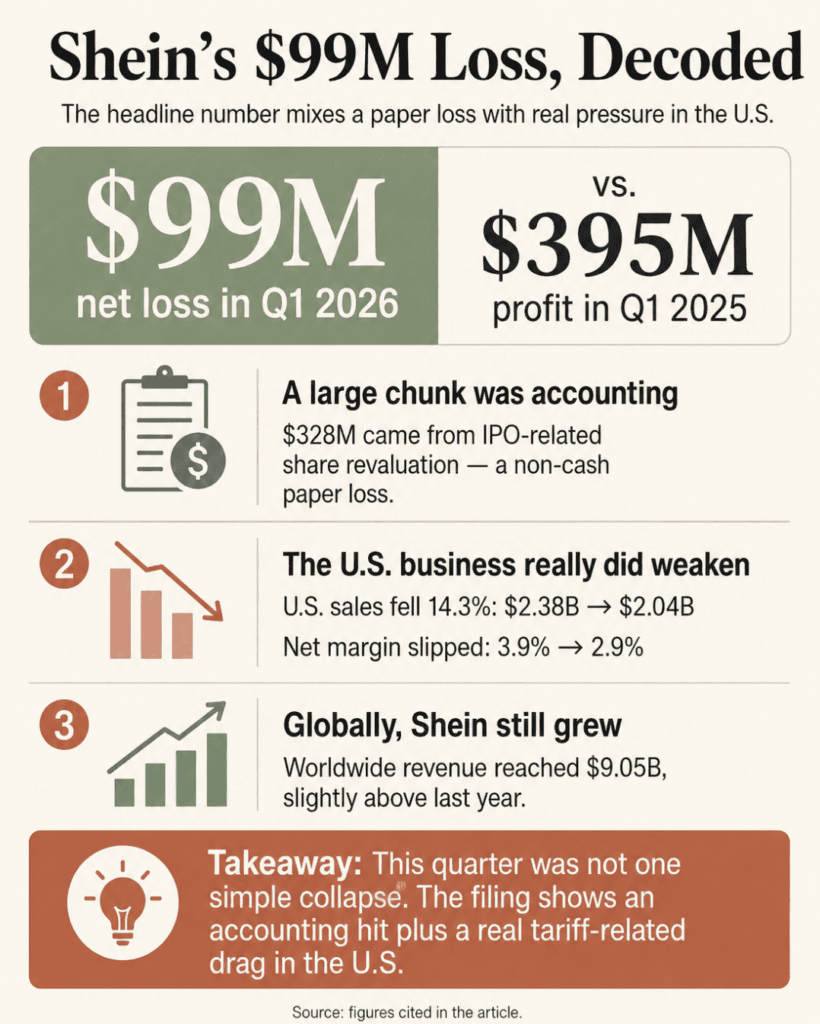
Shein’s Q1 2026 filing, submitted ahead of its Hong Kong IPO, shows a $99 million net loss for January through March, compared with a $395 million profit in the same quarter of 2025. Two separate things drive that swing, and they shouldn’t be treated as one story.
First, $328 million of that loss comes from an accounting rule, not the business itself. As Shein prepares to go public, it has to revalue certain investor shares on paper, and that revaluation shows up as a loss even though no actual money left the company.
Second, the part that actually traces to policy: Shein’s US sales fell 14.3 percent, from $2.38 billion to $2.04 billion, and it’s now making less profit on every sale, margin dropped from 3.9 percent to 2.9 percent. But worldwide, Shein still brought in $9.05 billion last quarter, slightly up from a year ago. This isn’t a company in trouble. It’s a company taking a real hit in one specific market.
How Are the US and EU Tariffs on Shein Different?
Neither of these rules was written with Shein’s name on it, they’re broad customs policy that happened to land hardest on companies like Shein because of how they ship. But the impact is real either way.
The US didn’t slow the loophole down, it shut it off completely. A rule used to let cheap packages from China, anything under $800, skip customs and import taxes entirely. That rule ended on May 2, 2025. Now those same packages get taxed anywhere from 10 to nearly 90 percent, depending on what’s inside. Shein said it straight up in its own paperwork: this hurt sales in the US.
Europe handled it differently. Starting July 1, 2026, the EU dropped its old rule (packages under €150 shipped tax-free) and replaced it with a flat €3 fee per item type in a shipment. So if you order ten of the same t-shirt, that’s €3 total. But order five t-shirts and five sweaters, that’s two different item types, so you pay €6. It’s a much smaller cost than what the US is charging, and it’s not permanent, it’s a placeholder rule that runs through 2028 until the EU builds a better tracking system.
Still, Shein isn’t brushing this off. The company told investors it expects Europe to eventually cost just as much as the US did, maybe more, and that’s a big deal since the US and Europe together make up over half of Shein’s total sales worldwide.
Were These Tariffs Ever Meant to Fix Fast Fashion?
These tariffs weren’t made to get people to buy less clothing. The US closed the loophole because companies were dodging customs duties, that’s a fraud problem. The EU’s own reasoning listed a few things: it’s unfair to European sellers who do pay duties, there are safety risks with unchecked packages, there’s a lot of fraud, and yes, environmental concerns, but that’s listed last, not first. Cutting how much clothing people buy was never the point.
So the real question isn’t “did this fix fast fashion.” It’s simpler than that: did it actually change how people shop? That’s a different question from the sustainability one, and it deserves its own honest answer instead of getting mixed in.
What Did Tariffs Actually Do to Shein and Temu Sales?
The week those US price hikes kicked in, Shein’s sales dropped 23 percent and Temu’s dropped 17 percent, according to Bloomberg data reported by Business of Fashion. Around the same time, another data source (Consumer Edge) showed spending down more than 10 percent at Shein and over 20 percent at Temu. Daily app usage fell too, 25 percent for Shein and 52 percent for Temu, according to NBC News. That part isn’t in dispute. It happened, fast, and it’s backed by multiple sources.
What happened next is fuzzier. One report said Shein’s sales started bouncing back while Temu kept sliding as it cut ad spending. But I don’t have full-year numbers that show how much of that early drop Shein actually made up, so I’m not going to pretend I do.
Did Zara, Asos, or Amazon Absorb Shein’s Lost Sales?
Right after the tariffs hit, plenty of people guessed the money would just flow to competitors, especially Zara and Asos. The actual year-end numbers don’t back that up.
Zara’s parent company, Inditex, grew sales 3.2 percent for the year. But Zara itself, the brand people expected to scoop up ex-Shein customers, only grew 1 percent, its slowest year in at least a decade. Zara’s slice of Inditex’s total business actually got smaller. That’s not a company cashing in on Shein’s problems. That’s a company slowing down.
Asos did worse. Revenue dropped almost 15 percent for the year. If Asos was supposed to be catching Shein’s overflow, its own numbers say otherwise.
Then there’s Amazon Haul, the cheap, direct-from-China marketplace Amazon launched in 2024. Amazon doesn’t publish sales numbers for Haul specifically, so there’s no way to confirm whether it picked up any of Shein or Temu’s lost business. I know Haul kept expanding into more countries. I don’t know if that expansion means it’s winning Shein’s old customers.
So here’s the honest takeaway: Shein and Temu’s sales dropped, that part is confirmed. Where that spending went is not confirmed. Nobody’s shown a clear winner yet, and that’s worth saying plainly instead of guessing.
How Did Shein Rebuild Its Shipping Model to Dodge Tariffs?
This next part is well documented. Instead of shipping small packages straight to individual customers, both Shein and Temu started shipping in bulk to warehouses inside the US. Why? Because bulk shipments get taxed based on wholesale prices, which are lower than retail prices, so the tariff bill shrinks. Temu’s been building warehouses to make this work, 13 of them worldwide as of late 2025, and expects US warehouses to handle up to a quarter of its total US business by 2026. In plain terms: losing the old shipping loophole didn’t shrink these companies. It just pushed them to find a new way to keep costs down.
Is Fast Fashion Actually Slowing Down?
Shein really did lose money. The tariffs are really costing them. But none of this tells me people are buying less cheap clothing overall, because nobody’s published the number that would prove that. What I can tell you is smaller but more honest: closing one shipping loophole didn’t make Shein or Temu shrink, it just made them find a cheaper workaround. If the real goal is getting people to buy fewer clothes and keep them longer, that’s a much bigger fight than one customs rule, and nothing here says it’s happening on its own.
There’s one dot worth connecting before closing this out. While Shein and Temu were losing sales, the U.S. secondhand apparel market grew 19 percent in 2025, its fastest growth since 2021, and outpaced regular clothing retail by more than three times over. Wells Fargo economists flagged an 8.5 percent jump in sales at stores that sell used goods and said they suspected people were buying secondhand specifically to dodge tariff price hikes. And in ThredUp’s own survey, 59 percent of people said they’d turn to secondhand if tariffs made new clothes cost more.
I can’t tell you the tariffs caused that growth, resale’s been climbing for years regardless of trade policy. But the timing lines up, and there’s a named analyst and a consumer survey both saying people are making that exact trade-off. That’s the more interesting story hiding under this one: the tariffs didn’t teach anyone to buy less. But for at least some people, they may have taught them to buy differently. That’s not nothing. It’s just not the same thing as the industry shrinking, and it’s worth being precise about which one actually happened.